Synopsis
A legal software product had matured organically, with critical product knowledge concentrated in individual team members and no prioritized roadmap to guide development. This is a natural stage for a growing product, but it was driving technical debt, unpredictable planning, and missed opportunities. The client engaged BP3, which ran discovery workshops with product leaders and built a "Now, Next, Later" roadmap organized around value. The result was clear alignment on direction, a value-focused product strategy, lower delivery risk, and better resource planning.
.svg)
Strategic Roadmapping: Bringing Product Direction to a Growing Legal Product
Most successful software products go through a stage that looks, from the inside, a little chaotic. The product grew because talented people made good decisions quickly, often before there was a formal product management function to guide them. Knowledge of how the application works accumulates in the people who built it. Priorities get set feature by feature. For a while, this works, because the people involved are capable and close to the product. But as the application grows larger, the absence of a shared, prioritized plan starts to cost more than it saves.
A legal software product had reached that stage. It was substantial and well established, but much of its product knowledge lived with individual team members rather than in any shared, documented form, and there was no single roadmap setting out what to build and in what order. Without that prioritized plan, development teams worked against shifting priorities, technical debt accumulated faster than it could be paid down, resource planning was difficult, and opportunities that deserved attention were easy to miss simply because nothing surfaced and ranked them.
The client recognized that the fix was not another push to ship features faster. What the product needed was a strategic layer above the day-to-day work: a way to decide, deliberately and collectively, what mattered most and when it should be delivered. The client engaged BP3 to build exactly that.
BP3 began with discovery. Rather than impose a plan from the outside, BP3 ran a series of workshops with the product team leaders who held the deep institutional knowledge. Those sessions surfaced and documented what had previously lived only in people's heads, mapped the underlying business processes that any modernization would depend on, and identified the largest bodies of work, the boulders that needed to be broken down into manageable, sequenced pieces.
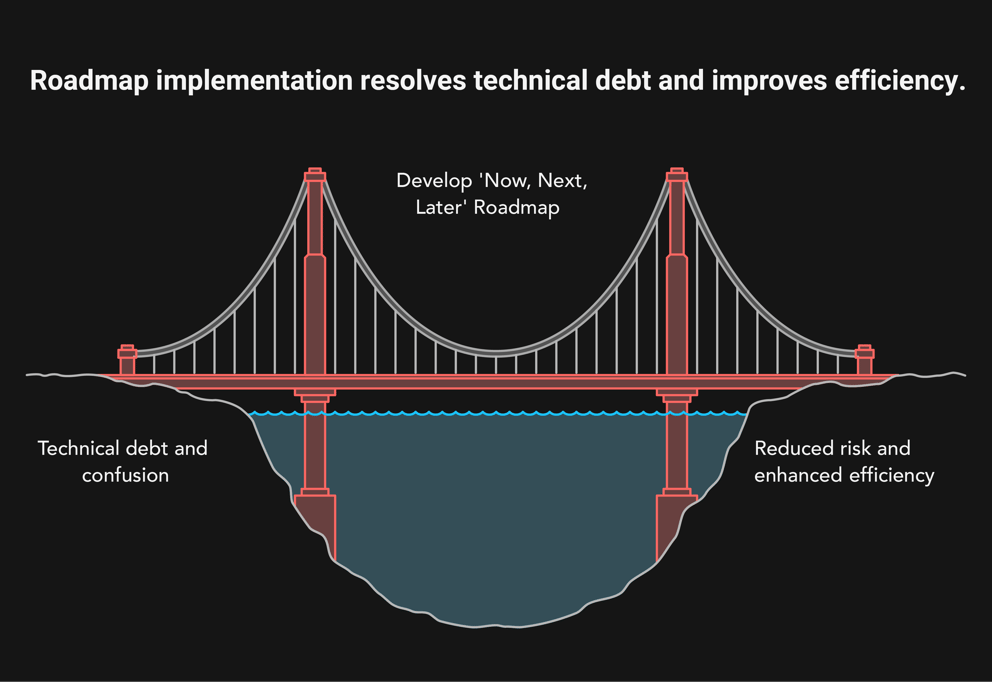
From that foundation, BP3 developed a "Now, Next, Later" roadmap. The framework is deliberately simple, and that is its strength. Rather than committing to precise dates far into an uncertain future, it sorts work into three horizons: what the team is delivering now, what comes next, and what is planned for later. Each item is prioritized by the value it adds, and the roadmap visualizes how that value is expected to accrue over time. Crucially, the roadmap was not built in isolation. BP3 secured buy-in from organizational leaders on both direction and priority, so the plan carried authority across the business rather than sitting with one team alone.
The impact went beyond having a document to point to. Stakeholders and the product team finally shared one view of where the product was headed and why, which replaced release-by-release negotiation with an agreed direction. Product management could focus on value and outcomes rather than sheer output, the perennial trap of busy teams. Delivery risk came down because work was sequenced deliberately and dependencies were understood in advance. Development ran more efficiently, and resource planning became something the organization could do with confidence.
The broader lesson reaches well beyond legal software. Products that grow organically almost always outrun their planning at some point, and knowledge concentrated in a few key people is a normal consequence of building quickly, not a mark against a team. What matters is recognizing when the product has reached the size where deliberate prioritization pays for itself, and then building the roadmap, and the alignment behind it, to match. This client made that move at the right time, and came away with a product strategy built around value rather than guesswork.