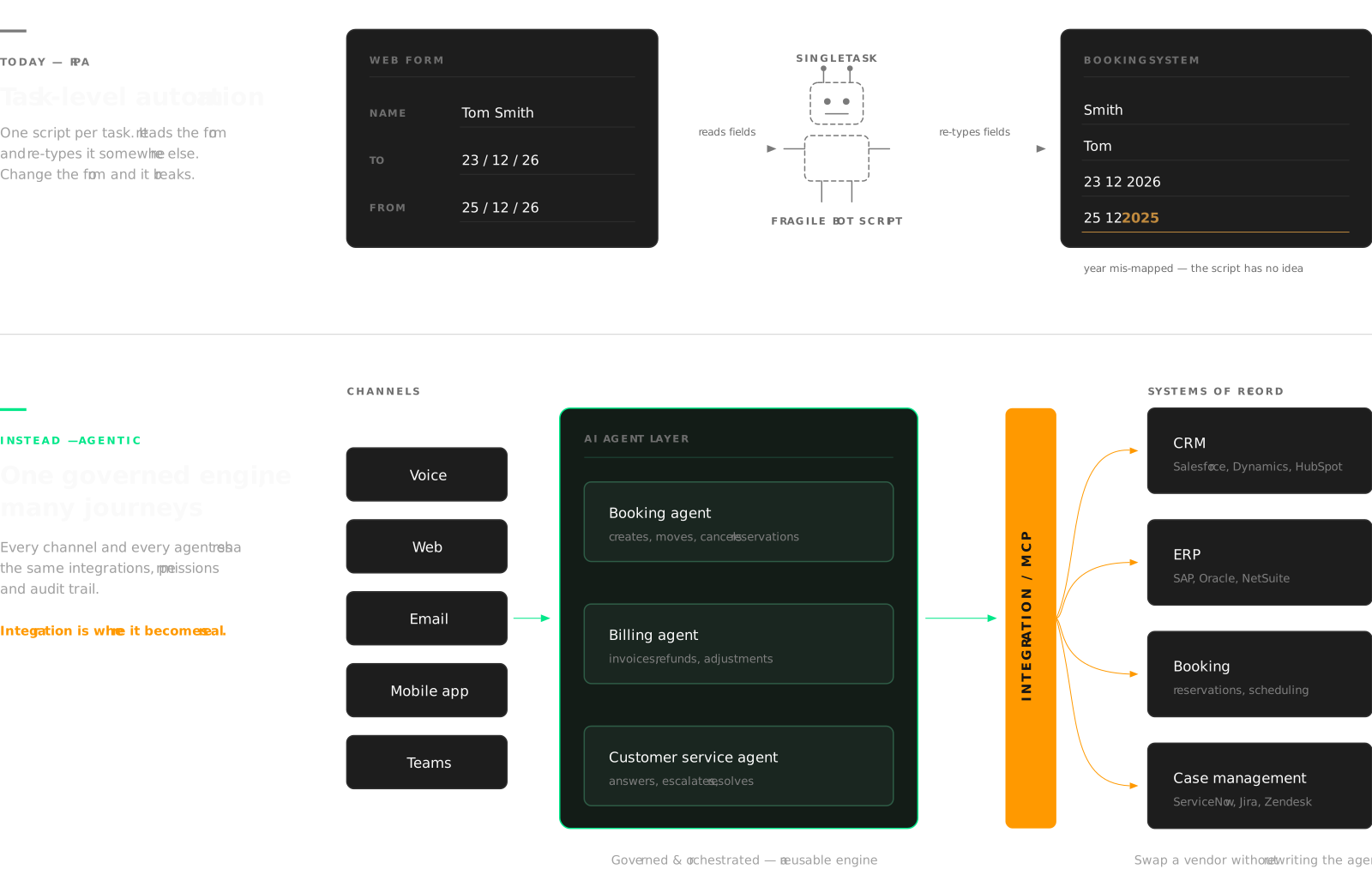
The Architectural Shift: Why Your AI CoE Is Not Simply a Rebranded RPA CoE
In the rush to capture the promise of enterprise artificial intelligence, many technology leaders are making a subtle yet costly assumption: treating AI implementation as a direct evolution of Robotic Process Automation (RPA).
As automation platforms rebrand themselves overnight as "AI-first" vendors, it is tempting to assume that existing governance frameworks, delivery pipelines, and validation models can simply be repurposed with a new engine under the hood.
They cannot.
If you are leading an enterprise automation or digital transformation function, applying RPA operating models to Agentic AI will obscure real business value, create technical debt, and restrict scalability.
Understanding why requires stepping back from vendor marketing and examining how work, data, and delivery architectures actually function across both paradigms.
1. Task-Level Execution vs. Process-Level Strategy
The core difference between traditional RPA and Agentic AI lies in the scope of engagement:
- RPA operates at the task level. It focuses on replicating detailed human-computer interactions—clicking buttons, scraping fields, and moving data between static interfaces. It operates on strict rules, largely unconcerned with underlying data quality or how work flows across the broader enterprise.
- AI Agents operate at the functional level. Agentic AI begins higher up the value chain, aligning directly with business strategy to analyze end-to-end workflows. Rather than merely automating a repetitive step within a fragmented process, AI agents evaluate how the process itself can be optimized or re-imagined to deliver a better business outcome.
Because RPA operates strictly at the micro-task level, its business cases traditionally rely on isolated productivity metrics (e.g., "hours saved"). Showing actual bottom-line cost reduction is notoriously difficult because the broader workflow remains fundamentally unchanged. AI Agents, by contrast, address the functional process as a whole, opening up clearer paths to structural efficiency and tangible operational ROI.
2. Point-to-Point Scripts vs. Reusable Micro-services
The fundamental architectural principles governing RPA and AI delivery are fundamentally opposed:
Traditional RPA delivery focuses on deterministic scripts designed to shift data between predefined systems with limited transformation. Unless an exact system-input/system-output scenario is duplicated elsewhere, these automations are rigid, isolated, and rarely reusable across different parts of the business.
AI Agents, on the other hand, should be designed as modular, autonomous micro-services. An agent is built to deliver a specific, high-value output from a set of inputs, independent of rigid UI elements.
Designing AI tools as micro-services offers distinct operational advantages:
- Cost Efficiency: Micro-services can be invoked across multiple business units without rebuilding core logic from scratch.
- Architectural Simplicity: Standardized API-driven integrations replace fragile, maintenance-heavy UI scripts.
- Scalable Governance: Centralizing AI functionality as discrete services allows Centre of Excellence (CoE) teams to monitor quality, manage context windows, and enforce compliance effectively.
Re-engineering the CoE Mandate
Adapting your CoE for the AI era is not about swapping software licenses it requires re-engineering how your organization identifies, validates, and maintains intelligent solutions.
|
Focus Area
|
Traditional RPA CoE
|
Modern AI CoE
|
|
Discovery Unit
|
Individual human tasks & button clicks
|
End-to-end functional workflows
|
|
Data Dependency
|
Low (works with UI data standard)
|
High (requires context & data readiness)
|
|
Primary Metric
|
Capacity created / FTE hours saved
|
Process optimization & business outcomes
|
|
Architecture
|
Monolithic, task-bound scripts
|
Modular, reusable micro-services
|
|
Governance Focus
|
System access & bot credentialing
|
Data quality, service reuse & output accuracy
|
Pragmatic Steps for Delivery Leaders
To successfully transition your governance model from task automation to true agentic orchestration, focus on four pragmatic shifts:
- Re-evaluate Opportunity Validation: Stop looking for low-complexity, high-volume click-tasks. Validate opportunities based on workflow friction, underlying data maturity, and strategic value.
- Mandate Modular Delivery: Treat every AI agent as a shared enterprise service rather than a bespoke point-solution. Build clear API boundaries and service contracts around every deployment.
- Operate Probabilistic Engines: Build the necessary semantic guardrails, context management, cost tracking and human validation layers that traditional micro-services never required.
- Upgrade Governance Frameworks: Shift your CoE’s focus away from managing UI breakage and credential logs, and toward monitoring data quality, model accuracy, and cross-functional service reuse.
The capability of your tools may have evolved overnight, but real business value is only realized when your operating model evolves to match it.